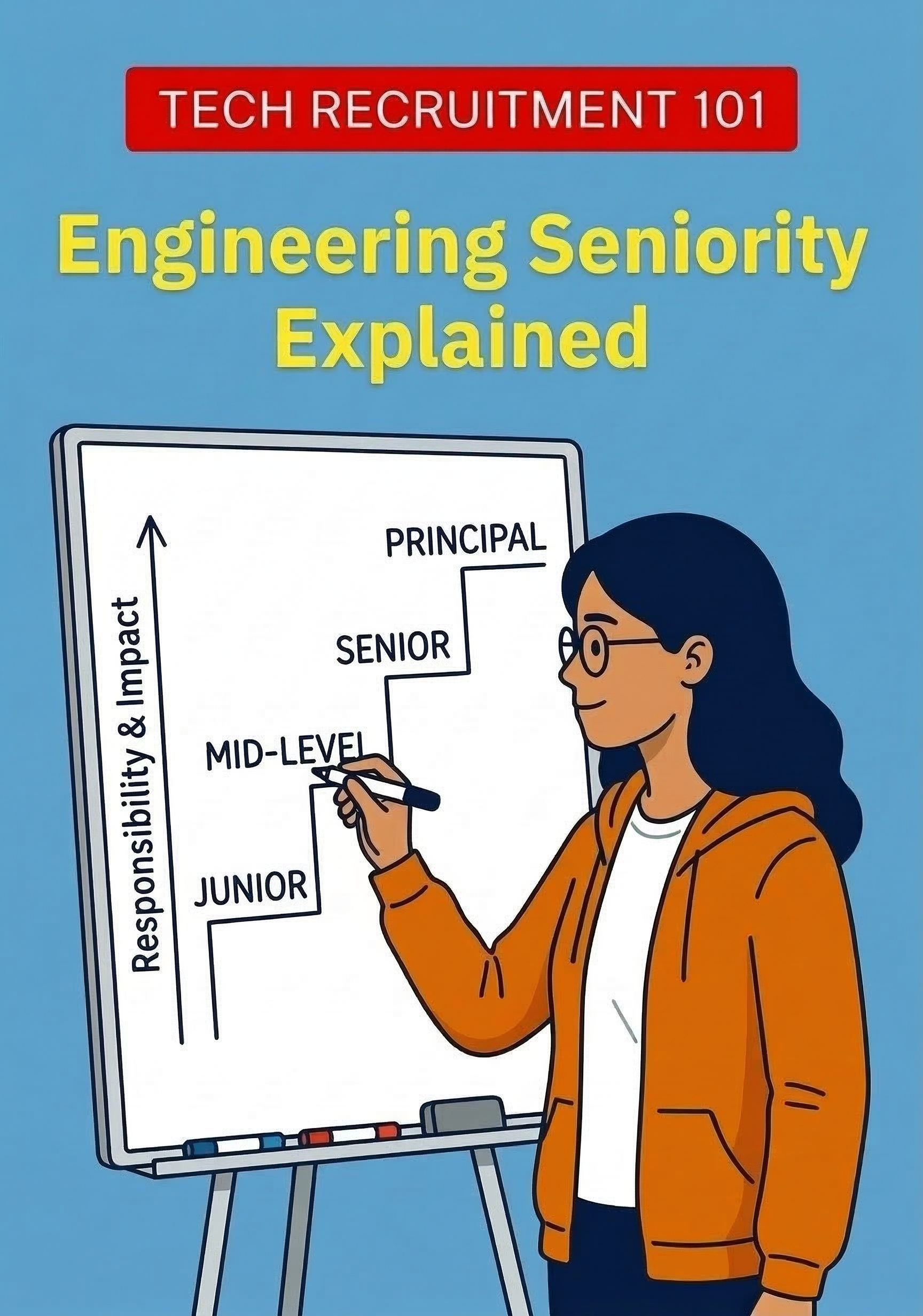
Engineering Seniority Explained
Introduction
I wrote this book because engineering seniority is one of the easiest things to mangle in recruiting. Not because recruiters are careless, but because the labels are messy, companies use them differently, and hiring managers often say "senior" when they mean three different things at once.
I have been on both sides of that conversation for years, as an engineer, a manager, and someone who has had recruiting as part of the job more times than I expected. What helped me most was dropping the idea that seniority is a prestige ladder and treating it as an operating model instead.
That shift makes the work much easier. You stop guessing from titles and start listening for what someone actually owns, how independently they work, what changes because they are there, and what people expect from them when things get messy.
This book is part of a broader set of practical guides I wish more recruiters had early on: short, usable, and written for real intake meetings rather than theoretical perfection. My goal here is simple. I want to give you a mental model you can use immediately to screen more accurately, run sharper calibration conversations, and avoid the very common mistake of treating every "senior" as the same hire.
What seniority actually measures
The most useful shift a recruiter can make is to stop treating seniority as a status label and start treating it as an operating model. In practice, I do not read level from title, years worked, or how polished someone sounds on the first call. I use four dimensions: scope, autonomy, impact, and expectations.
- Scope is the size and complexity of the problems someone owns.
- Autonomy is how much direction they need to operate well.
- Impact is the effect of their work beyond the task itself.
- Expectations are what the company relies on them to handle when things are unclear, risky, or politically awkward.
Those four tell you far more than "Senior Engineer" ever will.
| Dimension | What to listen for | Recruiter translation |
|---|---|---|
| Scope | Size and complexity of owned problems | How big is the area they truly own? |
| Autonomy | How independently they operate | How much direction do they need? |
| Impact | Effect on team, system, or business | Who is better off because of their work? |
| Expectations | What they are trusted to handle when things get messy | What happens by default when ambiguity shows up? |
This is why titles are such a weak shortcut. Companies inflate titles, compress ladders, borrow naming from larger firms, or use "lead" to mean whatever was easiest to put in the job title that week. I have seen two candidates with the same title operate at completely different levels. One owned a product area and made cross-team tradeoffs. The other executed well-scoped work inside a system designed by others. Same title, different operating range.
That is usually context, not dishonesty. A "senior" at one company may map to mid-level at another. A "lead" may mean technical owner, project coordinator, or simply the most experienced engineer in a small room. If you take titles literally, you will miscalibrate the search. The fix is a translation layer: What do they own? What decisions do they make alone? What breaks if they leave? What support do they still need?
A useful market signal is that compensation separates these levels for a reason. Levels.fyi's 2025 report shows clear median U.S. compensation gaps between entry-level, software engineer, senior, staff, and principal roles. Compensation is not a leveling framework, but it is a reminder that the market does not treat all "senior" work as one generic bucket.
AI makes title-reading even noisier. You will now see labels like "AI Engineer," "Applied AI Lead," or "LLM Engineer". LLM stands for Large Language Model, the kind of system behind tools like ChatGPT. Those titles can describe anything from prompt-heavy prototype work to serious production ownership. The same framework still applies.
That matters because AI-tool use is now normal. Stack Overflow's 2025 Developer Survey found that 84% of respondents are using or planning to use AI tools in development, and 51% of professional developers use them daily. The same survey found only 33% trust AI accuracy, 46% actively distrust it, and 66% say the biggest frustration is solutions that are almost right but not quite. In other words, output is faster, but judgment is still doing the dangerous part.
So when you hear a title, treat it as a clue, not a conclusion. Seniority is really about the size of problem someone can own, how independently they can handle it, how far their work reaches, and what everyone expects of them when the neat plan falls apart.
Reading the ladder from junior to principal
Once you have the framework, the ladder becomes easier to read. I come back to four questions: How wide is the scope? How much autonomy is expected? What kind of impact is normal? What support does this person still need?
Levels describe operating range, not worth. Junior does not mean weak. Principal does not mean superhero. And senior does not mean "mysterious wizard who fixes the roadmap in silence."
| Level | Typical scope | Autonomy and support | What usually differentiates them |
|---|---|---|---|
| Junior | Well-defined tasks within a team | Needs clear guidance, review, and prioritization help | Learning speed, reliability, coachability |
| Mid | Features or small projects | Works independently on familiar work, asks for help on ambiguity | Execution without constant supervision |
| Senior | Large features, systems, cross-team work | Handles ambiguity, makes sound tradeoffs, mentors others | Ownership, judgment, and consistent delivery |
| Staff | Multiple systems or a strategic technical area | Highly autonomous, aligns teams, shapes direction | Influence beyond own team |
| Principal | Organization-wide technical problems | Defines approach in very ambiguous space | Long-range technical judgment with broad business impact |
Junior
A junior engineer usually works on clearly defined tasks inside an existing system. They need regular review, context, and help with prioritization. That is normal. At this level, I am not looking for polished architecture thinking. I am looking for learning speed, basic debugging, follow-through, and whether they improve with feedback.
Mid-level
Mid-level is where engineers become reliably productive without constant structure. They usually own features or contained projects and can move familiar work from idea to completion. They still need help with harder tradeoffs, wider system consequences, or politically messy cross-team work.
This is where title confusion starts in earnest. One company's "Software Engineer" is another company's mid-level, and occasionally another company's senior. What matters is not the label but what they drove themselves and where they still needed a more experienced engineer to step in.
Senior
Senior is the level most often flattened into nonsense. Senior engineers are not just faster mids. They are trusted with important work that includes ambiguity. They make sound technical decisions, reduce load on the team around them, and usually mentor less experienced engineers.
The real shift is judgment. A senior engineer does not just finish work. They shape it. They think about safety, maintainability, risk, and whether an approach is worth the cost.
AI does not change that. Stack Overflow's 2025 Developer Survey shows broad AI adoption, but also low trust in output and meaningful debugging overhead. A senior engineer is distinguished by how they validate, de-risk, and own outcomes, not by how quickly they can prompt a tool.
Staff
Staff is where many recruiting processes get fuzzy. The title is common. The shape is not. A staff engineer usually operates across multiple teams, systems, or an important technical domain. They create leverage: setting direction, unblocking difficult architecture work, standardizing practices, or helping the organization make better technical decisions at scale.
The exact shape varies, which is why StaffEng is useful. It explains that many companies hide several different jobs behind the same staff title. That matches what I have seen. A staff engineer may act as a tech lead, but staff is broader than leading one difficult project well.
A useful test is simple: what changed beyond their own team because they were there?
Principal
Principal is narrower, less standardized, and easier to misuse than almost any other title. In many companies, principal engineers work on long-range, high-consequence technical problems that cut across the organization. They shape architecture, platform direction, risk posture, and technical strategy.
Platform here means shared internal systems, tools, or infrastructure that help many teams build and ship software more effectively. It is one of the clearest places where scope shows up, because the work creates leverage beyond one team.
Principal is not just staff with more years. The shift is usually toward broader business impact and decisions with a larger blast radius. If the wrong call will be expensive, this is often where principal-level judgment appears.
Lead is not a level, and manager is not the next step
This is one of the messiest parts of engineering hiring because companies use the same title for different jobs. "Lead" is the main offender.
In one team, it means a senior engineer who coordinates work. In another, it means technical owner of a system. In a third, it quietly means "the person already doing management without the title," which is not my favorite organizational design pattern.
The cleanest distinction I know is this:
- Level tells you how broadly and independently someone operates.
- Role tells you what kind of responsibility they carry day to day.
Those are related, but they are not the same.
Engineering Ladders is useful here because it separates developer, tech lead, Technical Program Manager (TPM), and engineering manager into different ladders instead of pretending they are automatic steps on one staircase. A TPM is someone responsible for coordinating complex technical work across teams, timelines, and dependencies, usually without being the main technical decision-maker.
| Role | What it usually means | What to listen for in intake |
|---|---|---|
| Lead | A responsibility label, not a stable level | Ownership of a project, system, or team coordination |
| Staff | Senior individual contributor with wider scope | Cross-team technical decisions and influence without direct reports |
| Principal | Very broad technical scope, usually organizational | Long-horizon architecture, strategy, and high-consequence decisions |
| Engineering manager | People manager accountable for team health and delivery | Hiring, feedback, performance, prioritization, team design |
A good shortcut is this: if the hiring manager talks mostly about code quality, design choices, technical direction, and production support, you are probably in lead or staff territory. Production support means the work of keeping live systems running when things break, slow down, or behave strangely. If they talk about performance reviews, coaching, compensation, and handling low performers, that is management.
Coordination is not management. Technical ownership is not management. Being the person everyone asks for help is also not management, though plenty of companies try to save budget by pretending otherwise.
The next common confusion is staff versus lead. StaffEng makes this point well: tech lead can be one mode of staff work, but many people do lead work without the broader organizational impact expected at staff level. That is the difference. Staff is wider scope, more influence, and more responsibility for how multiple pieces fit together.
Management is a different path, not the natural promotion after senior. Some excellent engineers move into management. Others should not, for the good of everyone involved.
Use intake questions that force clarity:
- Is this person accountable for people, or for technical outcomes?
- Will they write reviews and manage performance?
- Is the hardest part of the role depth, coordination, org influence, or coaching?
- Do you need one team to move faster, or several teams to align?
AI adds one more layer of title inflation. I now see "AI lead" or "head of AI" used before the company has a clear ladder underneath it. Treat those titles carefully. Stack Overflow's 2025 Developer Survey found that AI-tool use is now normal rather than exceptional, so using AI tools does not tell you much about level. Seniority still shows up in judgment, risk management, and decision ownership.
How to assess level in real recruiting conversations
This is where the framework becomes useful. In a real intake meeting or recruiter screen, you are not trying to prove whether someone can design a distributed system from scratch. A distributed system is a system made of multiple computers or services working together, often across networks. You are trying to understand level through evidence of scope, autonomy, impact, and judgment.
The simplest mistake I see is treating seniority as a proxy bundle: years of experience, famous employers, polished language, impressive keywords. Those signals can help, but they are weak on their own. A strong logo can hide very ordinary scope. A plain resume can hide someone carrying half a platform on their back.
What works better is to ask about the shape of the work.
Start with ownership. Ask, "What was yours to drive?" or "What were you expected to take from idea to production?" Idea to production means from the initial problem through release into the live system customers use. Junior candidates often describe assigned tasks and close guidance. Mid-level candidates usually own features or contained services. Senior candidates talk about owning outcomes, tradeoffs, dependencies, and what they were accountable for after launch.
Then probe ambiguity. Ask, "Tell me about a project where the requirements were unclear at the start. What did you do?" Listen for whether they waited for clarity, created clarity, or aligned others around a path. As level rises, the work usually gets less defined, not more.
Cross-team influence is another strong signal. Ask, "Who did you need alignment from to get this done?" and "How did you handle disagreement?" Mid-level candidates often coordinate within a team. Senior candidates work effectively across adjacent teams. Staff-level candidates influence without formal authority.
Decision-making matters more than fluency. Ask, "What options did you consider?" and "Why did you choose that approach?" I am listening for constraints, tradeoffs, and consequences, not just a polished story.
Failure recovery is especially revealing because rehearsed answers tend to wobble there. Ask, "Tell me about something that went wrong after release. What was your role?" Then ask, "What changed afterward?" Strong candidates talk not only about fixing the issue but about diagnosis, communication, prevention, and what they improved in the system or process.
AI belongs in this conversation too, but not as a novelty test. Stack Overflow's 2025 Developer Survey found that 84% of respondents are using or planning to use AI tools in development, while 45% said debugging AI-generated code is more time-consuming. Google Cloud's 2025 DORA report announcement also points to a positive relationship between AI adoption and software delivery throughput. DORA stands for DevOps Research and Assessment, a widely used body of research on how teams build and ship software. The practical recruiter takeaway is straightforward: higher output does not erase the need for senior judgment.
So instead of asking, "Do you use AI?" ask, "How do you review AI-assisted work?" and "What do you still validate carefully yourself?" That tells you far more.
In intake meetings, use the same lens with hiring managers. When someone says, "We need a senior," ask what they need that person to own in the first six months, what they can decide independently, and whether the role requires cross-team influence or mainly strong execution. Very often, "senior" means "solid mid-level engineer who needs less hand-holding." That is not a criticism. It is a better brief.
The reverse happens too. I have seen roles labeled staff that were really senior engineer roles with a slightly inflated title and a heroic wish list attached. A practical check is to ask whether this person must create leverage beyond their direct team. If not, it may not be staff.
In debriefs, keep the language concrete. "Strong communicator" is vague. "Owned a service end to end, handled production issues, and influenced two dependent teams" is useful. If you collect evidence in those terms, level becomes much easier to compare across candidates.
Where seniority breaks down in the real world
By the time you feel comfortable with a leveling framework, the market will hand you a resume that ignores it completely. That does not mean the framework failed. It means the title is noisy and your job is translation.
The most common source of noise is title inflation. Startups compress titles because they compress everything. One engineer may write production code, choose vendors, interview candidates, and act as a de facto tech lead in the same week. That does not automatically make them staff or principal. It may just mean the company is small and everyone is wearing too many hats, some of them borrowed.
Large companies create the opposite problem. Someone can hold a staff title inside a very structured environment where architecture, reliability, planning, and people management are split across multiple functions. Reliability here means keeping systems stable and available in real production use. That person may be excellent, but the title still needs translation when they move into a company with fewer boundaries and less support.
This is why role shape matters as much as title. Engineering Ladders is helpful because it treats developer, tech lead, TPM, and engineering manager as different ladders. StaffEng is equally helpful for staff-plus ambiguity, because it shows that several distinct jobs often hide behind the same title.
AI is creating fresh confusion for the same reason. Labels like "AI engineer," "AI lead," or "applied AI architect" can describe very different work. Gartner's May 2025 press release reported that 77% of engineering leaders saw AI integration in applications as a major challenge, and 71% saw AI tools augmenting software workflows as a significant or moderate pain point. So even in AI-heavy environments, ambiguity is not going away. If anything, it is becoming more expensive.
When I am unsure, I go back to the same four questions: What is the scope? How autonomous is this person? What is the impact of their decisions? What is expected of them when things are ambiguous? If you anchor there, odd titles become much less dramatic.
Conclusion
If you take one thing from this book, let it be this: engineering seniority is not a title problem. It is a translation problem.
Your job is not to memorize every ladder on the market or pretend title language is consistent when it plainly is not. Your job is to understand operating range well enough to turn vague reqs into real searches and polished resumes into grounded calibration.
That means listening for scope, autonomy, impact, and expectations. It means separating level from role shape. It means treating AI fluency as normal workflow rather than proof of seniority. And it means asking better intake questions before you spend weeks searching for a unicorn that was really a mid-level engineer with decent judgment all along.
In the other books in this series, I take the same approach: practical models, cleaner language, fewer myths. Recruiting gets much easier when you can translate what a team says it wants into what the work actually requires. Seniority is one of the best places to start.
Glossary
- AI (Artificial Intelligence) — Software that can generate, analyze, or recommend outputs that normally require human judgment.
- AI Engineer — A broad title for engineers working with AI systems. It can mean anything from prototype work to production model integration, so it needs translation.
- Applied AI — The practical use of AI inside products, workflows, or business systems.
- Architecture — The high-level design of a software system, including how its parts fit together.
- Blast radius — How wide the consequences are if a decision, failure, or change goes wrong.
- Debugging — Finding and fixing the cause of a software problem.
- De-risk — Reduce the chance or impact of failure before something is launched or changed.
- DORA (DevOps Research and Assessment) — Research on software delivery performance and engineering effectiveness.
- Distributed system — A system made of multiple computers or services working together.
- Individual contributor — A non-managerial role focused on technical work rather than direct people management.
- LLM (Large Language Model) — A type of AI model trained on large amounts of text and used for tasks like writing, coding, and question answering.
- Mid-level engineer — An engineer who can usually deliver defined work independently in familiar areas but still needs support with broader ambiguity or cross-team complexity.
- Platform — Shared internal systems, tools, or infrastructure that support many engineering teams.
- Principal engineer — A very senior individual contributor working on broad, high-consequence technical problems across an organization.
- Production — The live version of a system that real users rely on.
- Production support — Work involved in keeping live systems stable, available, and functioning correctly.
- Scope — The size, complexity, and reach of the problems someone owns.
- Senior engineer — An engineer trusted to handle important work with ambiguity, sound judgment, and broader ownership.
- Staff engineer — A senior individual contributor with influence and impact beyond a single team.
- Tech lead — A role focused on technical direction, coordination, and decision-making for a team, project, or system. It is a role shape, not a universal level.
- Title inflation — Giving a role a more senior-sounding title than the actual scope or expectations justify.
- TPM (Technical Program Manager) — Someone who coordinates complex technical work across teams, timelines, and dependencies, usually without being the main technical decision-maker.
- Tradeoff — A decision where improving one thing usually means giving up something else, such as speed versus quality or flexibility versus simplicity.